1

Country: USA | Funding: $3.9B
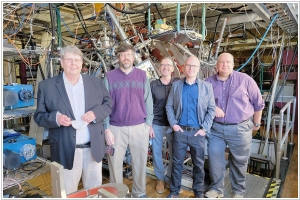
Commonwealth Fusion Systems is collaborating with MIT to create SPARC - the world's first fusion device that produces plasma that generates more energy than consumes. This compact, high-field tokamak will be built using high-temperature superconducting (HTS) magnets. CFS technology uses the new superconductor Rare Earth Barium Copper Oxide (REBCO) to produce the most powerful and most compact fusion magnets. Once SPARC is built, the company plans to build the world's first fusion power plant capable of generating hundreds of megawatts of power. CFS research is funded by the U.S. Department of Energy.
Commonwealth Fusion Systems is collaborating with MIT to create SPARC - the world's first fusion device that produces plasma that generates more energy than consumes. This compact, high-field tokamak will be built using high-temperature superconducting (HTS) magnets. CFS technology uses the new superconductor Rare Earth Barium Copper Oxide (REBCO) to produce the most powerful and most compact fusion magnets. Once SPARC is built, the company plans to build the world's first fusion power plant capable of generating hundreds of megawatts of power. CFS research is funded by the U.S. Department of Energy.
2
Country: China | Funding: CN¥800M
Energy Singularity is developing the HH70 tokamak, which utilizes high-temperature superconductors and has already set a world record for commercial fusion devices by maintaining a stable plasma current in long-pulse mode for 1,337 seconds. According to the company, this achievement was made possible through the continuous optimization of an AI-based plasma control system. The company aims to reduce the levelized cost of electricity generated by fusion plants to a level comparable to, or even lower than, that of thermal power plants.
Energy Singularity is developing the HH70 tokamak, which utilizes high-temperature superconductors and has already set a world record for commercial fusion devices by maintaining a stable plasma current in long-pulse mode for 1,337 seconds. According to the company, this achievement was made possible through the continuous optimization of an AI-based plasma control system. The company aims to reduce the levelized cost of electricity generated by fusion plants to a level comparable to, or even lower than, that of thermal power plants.
3

Country: China | Funding: CN¥2.4B
Startorus Fusion is a commercial nuclear fusion company, building spherical tokamak device SUNIST-2 in collaboration with Tsinghua University. The spherical tokamak, as a compact tokamak device, is more economical in terms of funding and space utilization. Due to its design, it has a higher ratio of plasma pressure to magnetic field pressure. The company already completed its first operational run, achieving a plasma current of 100 kiloamperes. It is the strongest magnetic field and highest-performance spherical tokamak in China. The startup is targeting technical verification by 2028 and pilot plant by 2032.
Startorus Fusion is a commercial nuclear fusion company, building spherical tokamak device SUNIST-2 in collaboration with Tsinghua University. The spherical tokamak, as a compact tokamak device, is more economical in terms of funding and space utilization. Due to its design, it has a higher ratio of plasma pressure to magnetic field pressure. The company already completed its first operational run, achieving a plasma current of 100 kiloamperes. It is the strongest magnetic field and highest-performance spherical tokamak in China. The startup is targeting technical verification by 2028 and pilot plant by 2032.
4

Country: UK | Funding: $287M
Tokamak Energy aims to accelerate the development of fusion energy. It designed, built and operated two of the world’s most advanced fusion facilities: ST40, the world’s highest-field spherical tokamak, and Demo4, the first HTS fusion magnet system to achieve fusion-relevant magnetic fields in a dedicated test facility. ST40 has already achieved a series of major milestones, including a plasma ion temperature of 100 million degrees Celsius, the threshold for commercial fusion energy, plasma current of 1 MA, demonstrating operation in high-performance regimes. ST40 is currently undergoing a major upgrade under LEAPS (Lithium Evaporations to Advance PFCs in ST40), a joint UK-U.S. programme supported by the U.S DoE.
Tokamak Energy aims to accelerate the development of fusion energy. It designed, built and operated two of the world’s most advanced fusion facilities: ST40, the world’s highest-field spherical tokamak, and Demo4, the first HTS fusion magnet system to achieve fusion-relevant magnetic fields in a dedicated test facility. ST40 has already achieved a series of major milestones, including a plasma ion temperature of 100 million degrees Celsius, the threshold for commercial fusion energy, plasma current of 1 MA, demonstrating operation in high-performance regimes. ST40 is currently undergoing a major upgrade under LEAPS (Lithium Evaporations to Advance PFCs in ST40), a joint UK-U.S. programme supported by the U.S DoE.
5

Country: China | Funding: CN¥1.5B
Neo Fusion is building and operating BEST (Burning Plasma Experimental Superconducting) tokamak at the Institute of Plasma Physics of the Chinese Academy of Sciences. It utilizes "burning plasma" i.e., regime close to self-sustaining nuclear fusion. Neo Fusion is 50% controlled by state-owned energy companies (China National Petroleum Corporation and Hefei Science Island) and the Chinese Academy of Sciences. The company plans to use nuclear fusion technology to produce enterprise energy appliances, providing businesses with clean energy technologies that generate electricity without generating radioactive waste.
Neo Fusion is building and operating BEST (Burning Plasma Experimental Superconducting) tokamak at the Institute of Plasma Physics of the Chinese Academy of Sciences. It utilizes "burning plasma" i.e., regime close to self-sustaining nuclear fusion. Neo Fusion is 50% controlled by state-owned energy companies (China National Petroleum Corporation and Hefei Science Island) and the Chinese Academy of Sciences. The company plans to use nuclear fusion technology to produce enterprise energy appliances, providing businesses with clean energy technologies that generate electricity without generating radioactive waste.
6

Country: China | Funding: $100M
SunUp Fusion is constructing its first-generation experimental device, compact high-field tokamak codenamed "Morning Light". The startup is pursuing a differentiated technological path centered on a Deuterium-Helium-3 (D-He3) fuel cycle. Its compact D-He3 power plants are designed for flexible deployment near urban centers or data hubs. This strategy would allow them to work in tandem with larger, remote D-T facilities to form an integrated and versatile energy grid.
SunUp Fusion is constructing its first-generation experimental device, compact high-field tokamak codenamed "Morning Light". The startup is pursuing a differentiated technological path centered on a Deuterium-Helium-3 (D-He3) fuel cycle. Its compact D-He3 power plants are designed for flexible deployment near urban centers or data hubs. This strategy would allow them to work in tandem with larger, remote D-T facilities to form an integrated and versatile energy grid.
7

Country: UK
UK Fusion Energy is leading the delivery of the STEP Fusion (Spherical Tokamak for Energy Production) - UK’s government-funded industry partnership program designed to scale a consistent fusion energy supply. It develops the prototype fusion energy plant at West Burton. The program coordinates plant design, engineering, technology development, site preparation, and industrial partnerships. Its objectives include demonstrating net energy production, fuel self-sufficiency, and a route toward commercial fusion power plants.
UK Fusion Energy is leading the delivery of the STEP Fusion (Spherical Tokamak for Energy Production) - UK’s government-funded industry partnership program designed to scale a consistent fusion energy supply. It develops the prototype fusion energy plant at West Burton. The program coordinates plant design, engineering, technology development, site preparation, and industrial partnerships. Its objectives include demonstrating net energy production, fuel self-sufficiency, and a route toward commercial fusion power plants.
8

Country: India | Funding: $7.2M
Pranos Fusion is building the tokamak technology across design software, control systems and High-Temperature Superconducting magnets, all integrated into a breakthrough small aspect-ratio tokamak. Its first low-aspect-ratio, medium-scale tokamak PRAGYA is built for advanced plasma control and integrated with JENGA - tokamak design and control software that integrates control-oriented design from the outset, ensuring that reactor design choices support stable operation.
Pranos Fusion is building the tokamak technology across design software, control systems and High-Temperature Superconducting magnets, all integrated into a breakthrough small aspect-ratio tokamak. Its first low-aspect-ratio, medium-scale tokamak PRAGYA is built for advanced plasma control and integrated with JENGA - tokamak design and control software that integrates control-oriented design from the outset, ensuring that reactor design choices support stable operation.